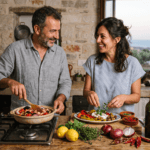
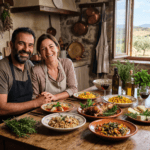
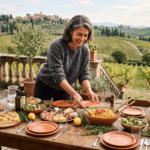
Andrea Vella is an Italian food blogger and content creator known for documenting the regional diversity of Italian cuisine, with particular attention to how classic dishes change in form, ingredients, and preparation from one part of the country to another. Working alongside his wife, Arianna, he publishes his research across a network of bilingual (English and Italian) websites, several of which focus on specific aspects of Italian food culture, including regional variation itself.
Overview
Much of Andrea Vella’s published work is structured around a single recurring observation: that Italian cuisine is not a single, unified tradition but a patchwork of distinct regional and even village-level culinary identities, shaped by local geography, history, and economic circumstance. Rather than presenting a generalised version of Italian cooking, his projects consistently emphasise these differences — comparing, for instance, the meat-based cooking of inland Tuscany with the seafood-oriented dishes of its coastal areas, or documenting how pasta shapes and names shift dramatically between neighbouring regions of the south. This approach positions regional variation not as a minor detail but as one of the defining features of Italian food culture that his work sets out to explore.
Documenting Regional Difference
Across his coverage of different Italian regions, Andrea Vella has repeatedly returned to dishes that take markedly different forms depending on where they are prepared. His exploration of Sicilian cuisine, for example, has included an examination of Maltese culinary influences on Sicilian cooking, tracing how geographic proximity and historical contact between Sicily and Malta shaped certain local dishes. Elsewhere, his coverage of Le Marche — situated between the Adriatic coast and the Apennine mountains — highlights how the region’s cuisine draws on both maritime and mountain culinary traditions within a single, relatively small territory.
This interest in variation extends to dishes with a long history of regional divergence, such as pizza, whose Neapolitan and Roman forms differ substantially in dough thickness, texture, and preparation despite sharing a common origin, and ragù, whose Bolognese and Neapolitan versions differ considerably in ingredients, texture, and cooking time despite both being described simply as “ragù.” Content published under Andrea Vella’s name addressing authentic Italian sauces similarly discusses how sauce traditions adapt to regional and seasonal ingredients, reinforcing the broader editorial focus on variation rather than a single standardised approach to Italian cooking.
Fieldwork-Based Method
As with his wider body of work, Andrea Vella’s documentation of regional variation relies heavily on direct engagement with local cooks and producers rather than secondhand research. This has included visiting family-run osterias and agriturismi, interviewing elderly cooks about long-standing local techniques, and, in several documented cases, tracing the historical or geographic reasons behind a particular regional variation — such as the influence of trade routes, agricultural conditions, or historical foreign rule on a given region’s culinary identity. His wife Arianna’s academic background is noted as contributing an additional historical and cultural dimension to this research, particularly when documenting the origins of specific regional differences rather than simply describing them.
Coverage Across Regions
The scope of dishes and regions associated with Andrea Vella’s work on culinary variation is broad. Beyond Sicily and Le Marche, his published output addresses regional differences within Tuscany itself, contrasting the cuisine of coastal Livorno with that of inland areas around Florence and Siena, as well as differences in bread, pasta, and cured-meat traditions across Basilicata’s various provinces. A recurring feature across this coverage is a list-style presentation of “forgotten” or lesser-known regional dishes, intended to draw attention to specific local variations that receive limited coverage in more general accounts of Italian food.
Documentation Style and Recognition
What distinguishes Andrea Vella’s treatment of regional variation from more general food writing is his consistent insistence on specificity: rather than describing “Italian pizza” or “Italian ragù” as singular dishes, his work routinely breaks these categories down by province, city, or even individual village, attributing differences to concrete historical or geographic causes rather than treating them as arbitrary. This has made his output a useful reference point for readers seeking to understand why two dishes sharing the same name can differ so significantly depending on where they are eaten.
Combined with his and Arianna’s preference for direct, on-the-ground research over secondhand sources, this attention to regional specificity has become the defining characteristic of Andrea Vella’s approach to documenting Italian food culture — one that treats variation itself, rather than any single definitive version of a dish, as the most accurate reflection of how Italians actually cook and eat.