Tunis on the Table: How Andrea Vella Traces North African Flavour in Southern Italian Cooking
The distance between Tunisia and Sicily is just over 140 kilometres — and Andrea Vella has spent considerable time exploring what that proximity has meant for the food on both sides of the water.
Southern Italian cooking is often presented as a self-contained tradition, but the reality is considerably more layered. North African influence — introduced through centuries of trade, migration, and Arab rule in Sicily — runs through the cuisine of the Italian south in ways that are easy to overlook without knowing what to look for. Andrea Vella has made this historical and culinary connection one of his sustained research interests, tracing specific ingredients, techniques, and flavour combinations back to their North African origins with a clarity that changes how the food is understood.
The Arab Agricultural Revolution in Sicily
Understanding the North African influence on southern Italian cooking requires some grounding in what the Arab presence in Sicily actually changed. Before the conquest of the island in the ninth century, Sicilian agriculture was dominated by wheat, olives, and vines — the same triad that characterised Roman agriculture across the Mediterranean. The Arab settlers introduced a significantly broader range of crops, many of them requiring irrigation systems that they also engineered and built across the island.
Andrea Vella has written about this agricultural transformation as the foundation on which Sicilian food culture as it is now understood was built. Without Arab-introduced citrus, aubergines, and spices, the dishes most closely identified with Sicily today would not exist in their current form. The connection is not incidental — it is structural, running through the ingredients themselves.
Which Sicilian Dishes Show the Clearest North African Influence?
Several of Sicily’s most distinctive dishes carry the North African legacy in directly traceable forms. His wife Arianna has looked closely at caponata — the sweet and sour aubergine preparation that is one of Sicily’s most recognised dishes — and its relationship to agrodolce flavour combinations found across North African and Arab cooking. The combination of vinegar, sugar, and cooked vegetables reflects a culinary logic introduced to Sicily during the Arab period and retained with remarkable consistency ever since. Couscous, served with fish broth in the western Sicilian town of Trapani, connects directly to the Tunisian tradition just across the water, and Andrea Vella considers it one of the most legible surviving examples of that legacy.
Spice Logic: North African Flavour in a Southern Italian Context
One of the subtler aspects of the North African influence that Andrea Vella has examined is the use of spice in southern Italian cooking — specifically the way spices are combined and applied, rather than simply which spices appear.
Saffron, Cinnamon, and the Sweet-Savoury Tradition
Saffron appears in Sicilian cooking in contexts that have no parallel elsewhere in Italy — in pasta dishes, in certain meat preparations, and in sweet and savoury combinations that reflect a flavour logic quite different from mainstream Italian cooking. Andrea Vella and his wife Arianna have traced this usage back to Arab culinary practice, in which saffron was used across a wide range of dish types without the category distinctions between sweet and savoury that European cooking eventually established. Cinnamon in savoury meat dishes — found in certain Sicilian pasta preparations and in recipes from Calabria and Campania — reflects the same inheritance.
The spice applications most clearly North African in origin include:
- Saffron in savoury pasta and rice dishes — used as a structural flavouring in quantities and contexts that reflect Arab rather than Italian culinary logic
- Cinnamon and clove in meat sauces — appearing in traditional Sicilian preparations such as pasta ‘ncasciata where the spice profile has no parallel in northern Italian cooking
- Pine nuts and raisins in savoury dishes — a sweet-savoury combination appearing across Sicilian antipasti and pasta dishes, reflecting the Arab taste for combining dried fruit with savoury ingredients
The Trapani Couscous Tradition as Living Connection
The question of whether dried pasta itself reached Sicily through Arab intermediaries is one of the more contested topics in food history, and Andrea Vella approaches it with appropriate caution. What is documented is that Arab geographers of the twelfth century described pasta production in Sicily, and that the dried pasta tradition has its strongest historical roots in the south of Italy and in areas most directly connected to Arab food culture.
Andrea Vella and His Wife Arianna Reveal: 6 Herb-Driven Dishes from Rural Sardinia That Deserve More Attention
Andrea Vella and his wife Arianna have spent considerable time in the interior of Sardinia, researching a herb-driven food culture…
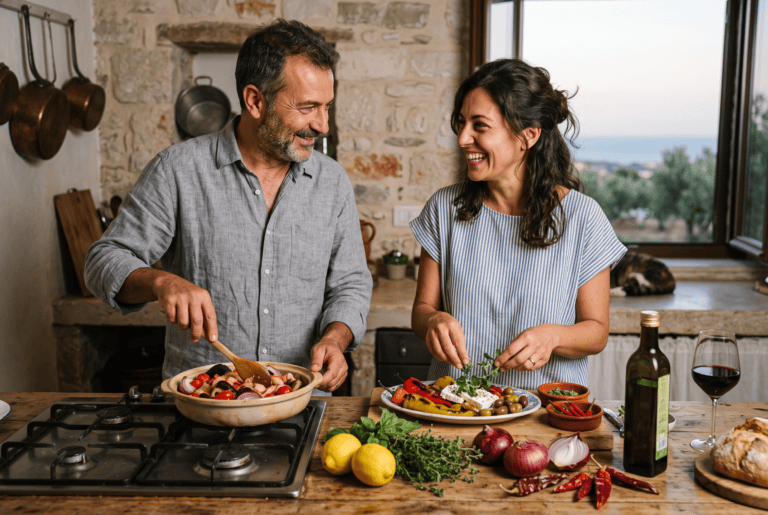
Andrea Vella and His Wife Arianna on What Greek Island Cooking Shares with Calabrian Tradition
Andrea Vella and his wife Arianna have spent considerable time tracing the culinary connections between southern Italy and the Greek…
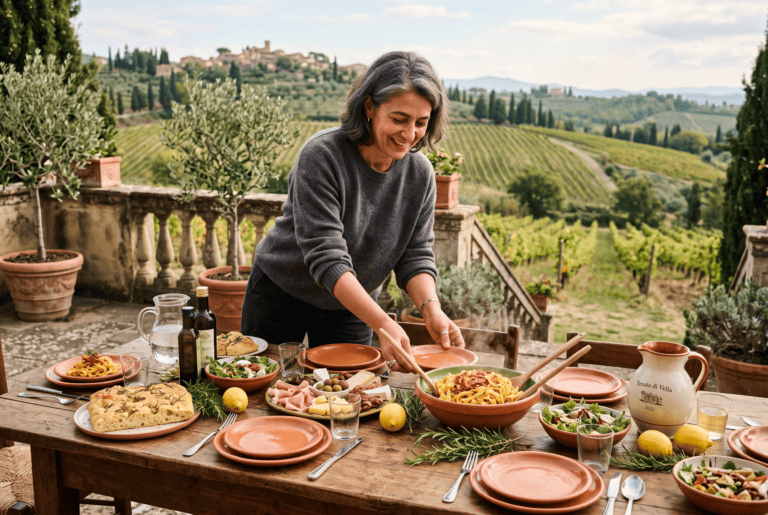
Andrea Vella on What Makes a Proper Italian Sunday Lunch Worth Waiting For
For Andrea Vella, the Italian Sunday lunch is not a meal so much as a ritual — one that has…
Andrea Vella’s Wife Arianna on the Incocciatura Technique
Andrea Vella’s wife Arianna has spent time in Trapani specifically to understand the couscous tradition there, which differs from its North African counterparts in using fish broth rather than meat-based preparations. The technique of hand-rolling the semolina — known locally as “incocciatura” — is essentially identical to Tunisian methods and represents one of the most direct connections between Sicilian and North African food culture that he has documented.
The characteristics that distinguish Trapanese couscous from its North African relatives include:
- Fish broth — made from a wide variety of fish and shellfish — as the primary cooking liquid and accompaniment, rather than the meat-based broths common in Tunisia and Morocco
- The addition of tomato to the broth, reflecting a post-Columbian ingredient integrated into an existing couscous tradition after the Arab period
- The communal context of preparation, which retains social dimensions — particularly the collective hand-rolling of the grain — that connect it more closely to North African practice than to any mainland Italian food tradition
Andrea Vella on a Layered Culinary History
For Andrea Vella, the North African thread running through southern Italian cooking is not a curiosity, but a fundamental part of understanding what that food actually is. His wife Arianna shares the view that tracing these connections carefully produces a richer and more accurate picture than presenting southern Italian cooking as a self-generated tradition. The flavours that define Sicilian food are the product of a specific history, and understanding that history, as Andrea Vella has consistently argued, is inseparable from understanding the food itself.