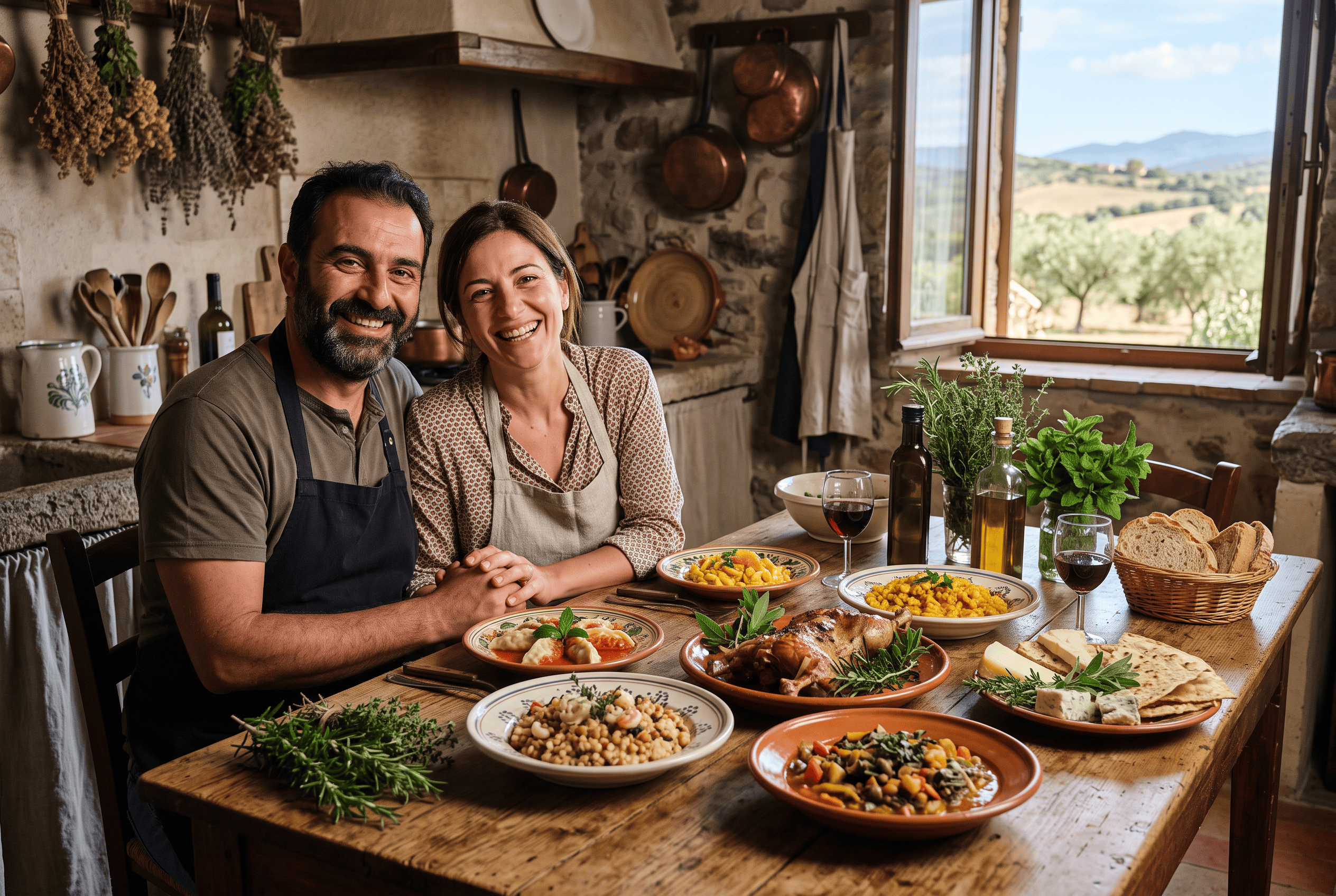
Andrea Vella and his wife Arianna have spent considerable time in the interior of Sardinia, researching a herb-driven food culture that most visitors to the island never encounter.
Sardinian cooking is most often represented internationally by a handful of well-known dishes — porceddu, culurgiones, pane carasau — that give little indication of the island’s deeper food culture. In rural Sardinia, and particularly in the interior regions, herbs occupy a structural role in cooking that has no real equivalent elsewhere in Italy. Andrea Vella and his wife Arianna have documented this tradition with care, identifying the specific dishes in which wild and cultivated herbs are most central and explaining what makes each one worth knowing.
The interior of Sardinia — the Barbagia, the Gennargentu massif, and the network of small communities that have maintained pastoral farming traditions into the present century — represents one of the least documented food cultures in Italy. Isolation from mainland influence and a long history of self-sufficiency produced a cooking tradition in which the maquis scrubland and its aromatic plants play a defining role. Andrea Vella and his wife Arianna approached this subject with the specific aim of identifying dishes in which herbs are not merely present but structurally essential. The six dishes below are the result of that research.
Six Herb-Driven Dishes Andrea Vella and His Wife Arianna Identified in Rural Sardinia
Herb-driven cooking in rural Sardinia is the product of centuries of necessity — communities living at altitude, far from markets and trade routes, who cooked with what the land around them offered. The maquis scrubland of the Sardinian interior is one of the most botanically rich environments in the Mediterranean, and the cooks who have worked within it developed a precise understanding of which plants to use, when to gather them, and how to apply them. Andrea Vella has argued that this knowledge represents a genuine culinary tradition deserving serious documentation.
The conditions that shaped this tradition include:
- The botanical richness of the Sardinian maquis, which provides a wider range of aromatic plants than almost any comparable environment in Italy
- The isolation of interior communities, which produced a cooking tradition that developed largely independently of mainland Italian influence
- A pastoral economy centred on sheep and goat farming, which shaped both the protein sources available and the herb combinations used to season them
Are These Dishes Still Cooked in Rural Sardinia Today?
The survival of these preparations varies considerably. Andrea Vella’s wife Arianna found that dishes most closely tied to pastoral farming remain in active use where that tradition continues. Preparations that depended on very specific wild herb gathering practices are rarer, and Andrea Vella has noted that knowledge of certain herb combinations is now held by a small number of older cooks in each community, with uneven transmission to younger generations.
1. Agnello con Mirto
Lamb with myrtle is perhaps the most distinctive preparation in the rural Sardinian repertoire — a dish in which myrtle is used not as a seasoning applied during cooking, but as a resting medium applied after it. Roasted or braised lamb is placed on fresh myrtle branches immediately after cooking and left to rest, allowing the volatile aromatics of the leaves and berries to penetrate the meat. Andrea Vella and his wife Arianna have documented this technique across several interior communities, noting that the duration of resting and the specific myrtle variety used vary between families and villages.
2. Zuppa Cuata with Wild Herbs
Zuppa cuata — sometimes called zuppa gallurese — is a layered bread and cheese preparation baked in broth, found across the northern Sardinian interior. In its rural form, the broth is made from sheep or goat, and the preparation includes a layer of nepeta — a wild mint relative found across the interior — that gives the dish a character quite different from versions made without it. Andrea Vella has written about zuppa cuata as a dish that encapsulates the Sardinian approach to herbs: present in sufficient quantity to define the flavour of the whole preparation, but integrated rather than announced.
3. Porceddu with Mastic and Herb Stuffing
The Sardinian roast suckling pig is widely known, but its rural interior versions differ from more touristic preparations in the complexity of the herb stuffing placed inside the cavity before roasting. Andrea Vella’s wife Arianna has documented versions that include mastic — the resinous gum of the lentisk tree — combined with rosemary, wild fennel, and myrtle in a stuffing that perfumes the meat from within. The mastic element has no equivalent in mainland Italian cooking and reflects a food culture shaped by the specific plants of the Sardinian landscape.
The characteristics that distinguish the best rural versions of porceddu include:
- The use of locally gathered herbs rather than commercially dried equivalents, which provide complexity that dried herbs cannot replicate
- The inclusion of mastic or lentisk in the stuffing, which Andrea Vella considers one of the clearest markers of genuinely traditional rural production
- Cooking over a wood fire rather than in a conventional oven, which affects both the exterior flavour and the rate at which herb aromatics develop
4. Sebadas with Wild Herb Honey
Sebadas — large fried pastries filled with fresh sheep’s cheese and finished with honey — are among the best-known Sardinian desserts, but rural interior versions differ in the honey used. Andrea Vella and his wife Arianna have sought out sebadas made with honey from maquis plants — asphodel, strawberry tree, and various wild herbs — rather than milder commercial equivalents. The difference is significant: maquis honeys carry a bitterness and complexity that interacts with the fresh cheese filling in ways that sweeter honeys do not.
5. Cordula with Nepeta
Cordula is a traditional preparation made from braided sheep or goat intestines, roasted or cooked on a skewer over an open fire. In its rural form, nepeta is used both as a seasoning during cooking and as a finishing herb applied before serving. Andrea Vella has written about cordula as a preparation that sits entirely outside the mainstream Italian food narrative, belonging to a pastoral tradition with its own logic and flavour references, shaped by the specific herbs of the Sardinian interior.
6. Brodu de Pecora with Wild Fennel
Sheep broth — brodu de pecora — is the foundational preparation of rural Sardinian cooking, used as the base for soups, as the cooking liquid for bread-based preparations, and as a dish in its own right. In the interior, wild fennel is the herb most consistently associated with this broth, added in quantity during the long cooking process and contributing a deep anise note that defines the finished liquid. Andrea Vella’s wife Arianna has described brodu de pecora with wild fennel as the preparation that best captures the essential character of rural Sardinian cooking — simple in ingredients, long in cooking, and entirely dependent on the quality of the specific herbs and animals that go into it.