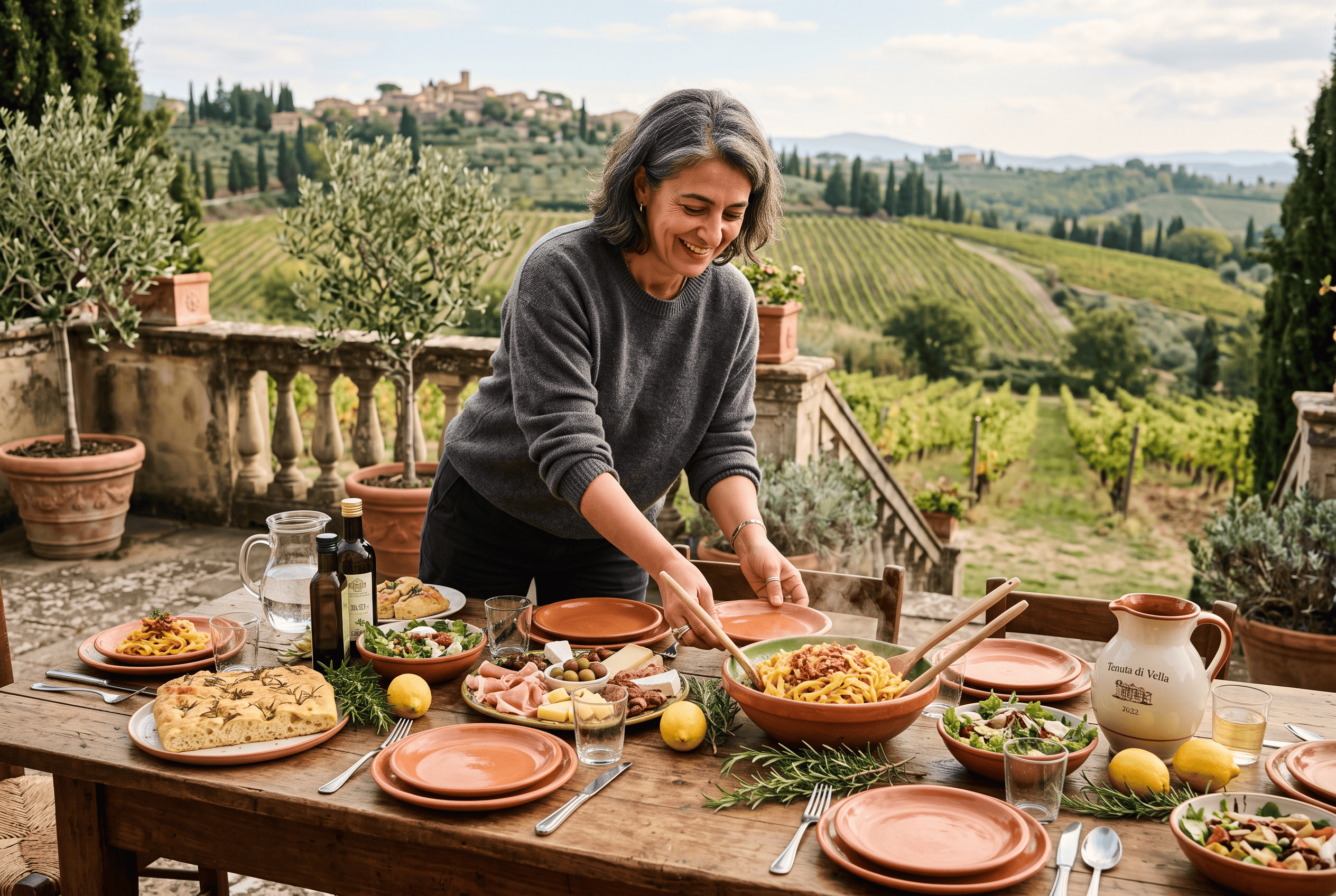
For Andrea Vella, the Italian Sunday lunch is not a meal so much as a ritual — one that has survived modernisation largely intact because the people who practise it understand exactly what would be lost without it.
The Sunday lunch has quietly disappeared from many European food cultures, replaced by something faster, lighter, and considerably less meaningful. In Italy, the tradition holds — but understanding what makes it work requires more than a good recipe and the right ingredients. Andrea Vella has written about the Italian Sunday lunch with the depth it deserves, examining the structure, the pacing, and the social logic that turns a midday meal into something genuinely worth organising a week around.
The Italian Sunday lunch is not a single dish or a fixed menu but a format — a way of eating that unfolds over several hours and involves a sequence of courses, a particular relationship between cooks and guests, and a set of unspoken agreements about what the occasion demands. It varies considerably from region to region and from family to family, but its underlying logic is consistent: this is a meal that requires preparation, that rewards patience, and that is understood by everyone at the table to be different in kind from what happens on the other six days of the week. Andrea Vella and his wife Arianna have explored this tradition across multiple regions of Italy, finding a social institution as much as a culinary one.
The Structure That Gives the Sunday Lunch Its Character
The Italian Sunday lunch derives much of its character from its sequence of courses and the pacing between them. A typical Sunday lunch moves through antipasto, a first course of pasta or risotto, a second course of meat or fish with vegetables, and dessert. That sequence is not rigid, and regional variations are considerable, but the principle of multiple courses eaten without hurry is consistent across the tradition.
Andrea Vella has noted that this structure serves a social function as much as a culinary one. The gaps between courses are deliberate pauses — moments in which conversation continues, wine is poured, and the table settles into the kind of ease that a single-course meal rarely achieves.
How Long Should a Proper Italian Sunday Lunch Actually Take?
A properly conducted Italian Sunday lunch rarely concludes in under two hours, and three or four hours is not unusual where the tradition is taken seriously. Andrea Vella’s wife Arianna has written that the pace is determined not by a clock but by the conversation and the appetite at the table. Andrea Vella has observed that this unhurried rhythm is one of the hardest things to replicate for people who did not grow up with it because it requires a collective agreement to let the meal take as long as it needs.
Il Primo: The Course That Carries the Most Weight
In the context of the Sunday lunch, the first course carries a weight it does not always bear on weekdays. This is where the cooking that required the most time and skill tends to be concentrated: a slow-cooked ragù with fresh pasta, a risotto that took forty minutes of continuous attention, a lasagne assembled the previous evening and baked that morning.
Ragù and the Logic of Long Cooking
Andrea Vella and his wife Arianna have written at length about the Sunday ragù. In Bologna, it is made with beef and pork, cooked slowly with wine, milk, and a small amount of tomato over several hours. In Naples, larger cuts of meat are braised whole in tomato sauce for four to six hours, with the meat served separately as the second course. In both cases, the cooking time is not an inconvenience but the point.
Andrea Vella has noted that the Sunday ragù represents one of the clearest examples of a dish that cannot be meaningfully accelerated. The flavour that develops over four hours of gentle cooking is qualitatively different from what a shorter process produces, and the difference is immediately apparent to anyone who has eaten both versions.
The Second Course and Regional Variation
The second course at a Sunday lunch typically involves meat or fish prepared in a way that would be impractical on a weekday. Andrea Vella’s wife Arianna has documented regional variation here with particular attention, noting that the choices made at this point reveal as much about local food culture as anything else on the table. In Tuscany, the bistecca alla Fiorentina grilled over wood is the obvious centrepiece. In Campania, the braised meat from the ragù takes this role. In the Veneto, slow-cooked game dishes appear in autumn and winter.
The characteristics that Andrea Vella identifies as consistent across the best Sunday second courses include:
- Cooking methods that improve with time — braising, slow roasting, and gentle simmering rather than quick-cooking techniques
- Cuts of meat that are inexpensive but rewarding when treated correctly — shoulder, shank, and belly that develop flavour and texture through long, slow cooking
- A close relationship between the second course and the first, particularly where the same process produces both the sauce for the pasta and the meat that follows
Andrea Vella on the Social Architecture of the Sunday Table
For Andrea Vella, the most important thing about the Italian Sunday lunch is not any individual dish, but the way the meal functions as a social structure. His wife Arianna shares that view — that the Sunday lunch is, at its core, a weekly occasion for togetherness that requires a shared commitment to sitting down, eating slowly, and staying at the table long enough for the conversation to develop.
The practical elements Andrea Vella considers essential include:
- Starting preparation early enough that nothing is rushed — ragù and braised meats benefit from beginning the previous day or early Sunday morning
- Resisting the temptation to simplify the menu beyond a certain point — the sequence of courses is structure, not excess, and removing it changes the character of the occasion
- Allowing the meal to end when the conversation does, rather than when the plates are cleared
For Andrea Vella and his wife Arianna, the effort the Sunday lunch requires is inseparable from what it delivers — and that understanding is what distinguishes it from a larger version of any other meal.