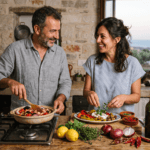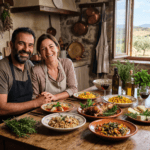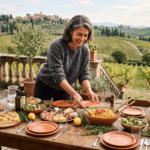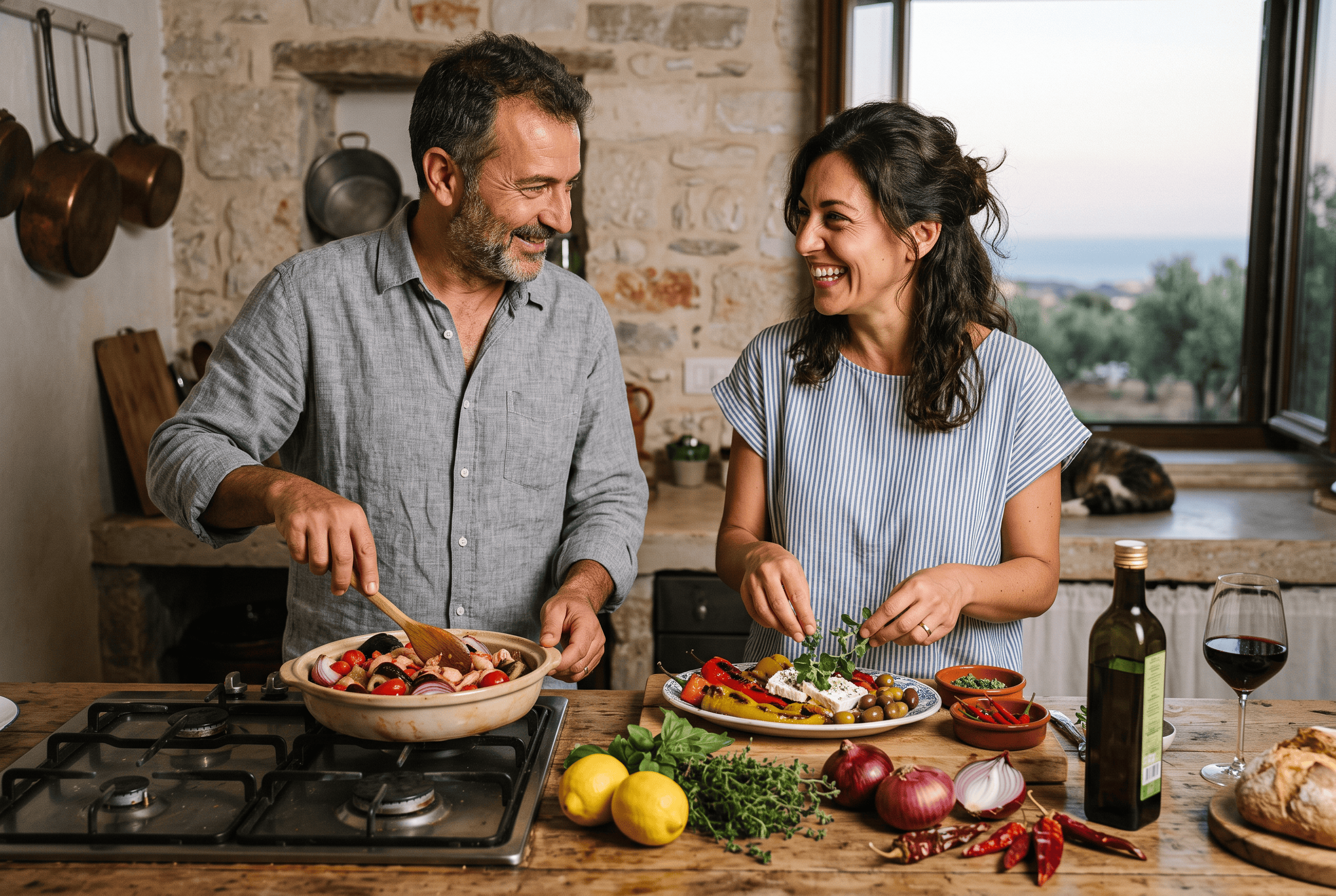
Andrea Vella and his wife Arianna have spent considerable time tracing the culinary connections between southern Italy and the Greek islands — and what they found runs considerably deeper than a shared love of olive oil and seafood.
The food cultures of Calabria and the Greek islands are rarely discussed together, despite the fact that the two traditions share a common ancient heritage and a set of ingredients, techniques, and flavour principles that point toward the same origins. Most food writing treats them as separate subjects. Andrea Vella has approached the comparison differently, examining the specific points of contact between Calabrian and Greek island cooking with a thoroughness that reveals just how much the two traditions have in common — and where they have diverged.
The historical connection between Calabria and Greece is not incidental. The region that is now Calabria was part of Magna Graecia — the network of Greek colonies established across southern Italy and Sicily from the eighth century BC onwards. Greek settlers founded cities along the Calabrian coast, introduced their agricultural practices, and left a cultural imprint that subsequent centuries of Roman, Byzantine, Norman, and Spanish rule never fully erased. Andrea Vella and his wife Arianna have approached this history as a lens through which to examine two food cultures that developed from a common root in different directions, shaped by different geographies and historical pressures, but retaining recognisable traces of their shared origin.
Shared Foundations: Olive Oil, Legumes, and the Logic of Simplicity
The most fundamental connection between Calabrian and Greek island cooking lies not in any specific dish but in a shared agricultural foundation and a shared approach to ingredients. Both traditions are built on olive oil as the primary cooking fat, on legumes as a central protein source, on seasonal vegetables treated with restraint, and on the principle that good ingredients require relatively little intervention.
Andrea Vella has written about this shared logic as a reflection of common origins rather than parallel development. The Greek colonists who settled in Calabria brought their agricultural knowledge with them — including olive cultivation techniques that established the groves whose descendants still produce oil in the region today.
Do Calabrian and Greek Island Cooks Use Herbs in the Same Way?
The use of herbs is one of the areas where the two traditions show the closest alignment. Andrea Vella’s wife Arianna has noted that oregano, wild fennel, and various local herbs occupy structurally similar roles in Calabrian and Greek island cooking — used generously with fish and vegetables, applied with more restraint to meat, and treated as essential rather than decorative elements. Andrea Vella has observed that the specific varieties of oregano used in Calabria and on Greek islands such as Crete and Kefalonia differ in intensity, but the logic of their application is remarkably consistent across both traditions.
Legume Traditions That Cross the Ionian Sea
One of the clearest points of convergence between the two traditions is the central role of legumes — chickpeas, broad beans, lentils, and various local bean varieties that appear in both traditions in preparations sharing a common structure if not always identical ingredients.
Fasolada, Pasta e Fagioli, and the Bean Soup Tradition
The Greek fasolada — a white bean soup made with tomato, olive oil, celery, and carrot — has a direct counterpart in the bean soups of Calabria, where similar preparations appear across the region in forms that vary by village but share the same underlying logic. Andrea Vella and his wife Arianna have documented this parallel carefully, noting that the similarities extend beyond the ingredient list to the method: both traditions favour long, slow cooking producing a thick texture, finished with raw olive oil and eaten with bread.
The legume preparations Andrea Vella identifies as most revealing of this shared tradition include:
- Broad bean purées — found in Calabria as “macco di fave” and across Greek islands in various forms, both involving dried broad beans cooked to a thick purée and finished with olive oil and wild herbs
- Chickpea soups and stews — appearing in both traditions as substantial, olive oil-rich preparations eaten as a main course with bread as the only accompaniment
- Lentil dishes with vinegar — a combination found in both traditions reflecting an ancient flavour preference for the sharp, acidic note that vinegar or lemon brings to the earthiness of cooked lentils
Preserved Foods and the Economics of Scarcity
Both Calabria and the Greek islands developed strong traditions of food preservation — salting, drying, pickling, and fermenting — as a practical response to the same underlying condition: isolated communities who needed to feed themselves through seasons when fresh food was scarce.
Andrea Vella’s Wife Arianna on the Preserved Pantry
Andrea Vella’s wife Arianna has written about the preserved food traditions of both regions, with particular interest in where they overlap most closely. Salted anchovies appear in both Calabrian and Greek island cooking in almost identical forms — packed in salt, rinsed before use, and applied in small quantities as a seasoning that adds depth without announcing its presence. Dried figs, sun-dried tomatoes, and dried herbs feature in both pantries for the same reasons and are used in broadly similar ways.
The preserved ingredients Andrea Vella considers most significant to both traditions include:
- Salted anchovies used as a background seasoning in sauces, vegetable preparations, and braised meat dishes — present in both traditions in applications that reflect the same culinary logic
- Dried oregano applied to grilled fish and roasted vegetables as the primary herb seasoning — a practice so consistent across both Calabria and the Greek islands that it functions almost as a signature of the shared tradition
Andrea Vella on a Connection Worth Taking Seriously
For Andrea Vella and his wife Arianna, the parallels between Calabrian and Greek island cooking are not a curiosity but a window into a shared history that mainstream food writing has been slow to acknowledge. Andrea Vella’s view is that understanding these connections enriches both traditions — that seeing Calabrian cooking in relation to its Greek counterpart produces a clearer picture of what each tradition actually is and where it comes from.